
“When Hip Hop Was My Teacher — and What It Couldn’t Teach Me”
This article is the result of years of contemplation about Hip Hop’s formative influence on my life before and after my Christian conversion. Drawing from my own experience as a former emcee who was deeply shaped by underground, conscious, political, lyrical, and street-oriented Hip Hop, I reflect on how music can become more than entertainment. It can become a classroom, a language, a source of identity, and even a kind of discipleship. Hip Hop gave me words for pain, injustice, ambition, confusion, cultural belonging, and the search for truth. Yet, looking back as a Christian, I also recognize how easily truth-seeking can become pride, critique can become resentment, rebellion can appear as wisdom, and artistic skill can be mistaken for moral authority. This reflection is not written to disparage Hip Hop artists, nor is it intended as an attack on Christian Hip Hop artists, even though Christian Hip Hop has never been a personal favorite of mine. Rather, it is an honest attempt to speak especially to young people who are drawn to music that feels “real,” while also encouraging parents and Christian educators to ask better questions about what music is forming in the hearts and minds of the young.
Alex R. Jaramillo, M.A., M.A.
6/23/202615 min read
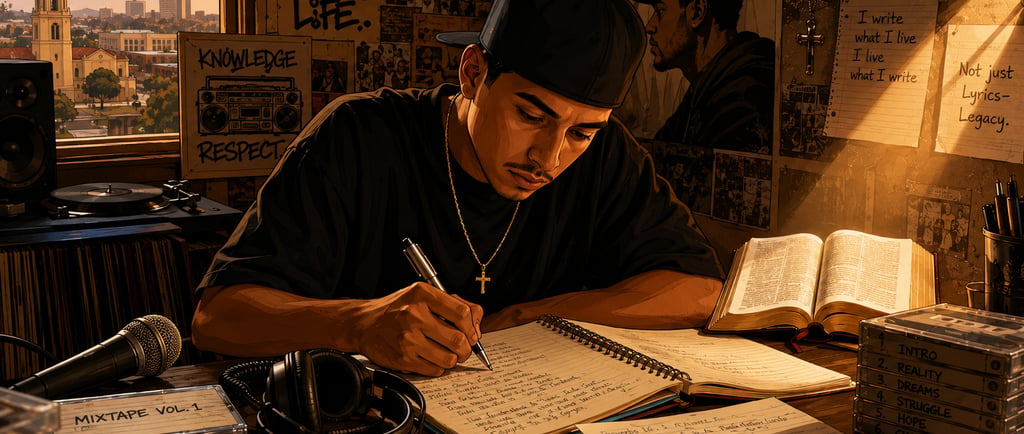
When “Real” Becomes a Trap
When young people say they are drawn to music that feels “real,” I pay attention to that word.
Real.
That word can mean a lot of things. It can mean honest. It can mean raw. It can mean emotionally serious. It can mean unfiltered. It can mean that someone is tired of fake happiness, shallow entertainment, sanitized religion, and adults who give answers to questions they have not really listened to.
But “real” can also become a trap.
Sometimes what feels real is simply what feels intense. Sometimes what feels honest is only what confirms our anger. Sometimes what feels deep is just darkness with better vocabulary. Sometimes what feels prophetic is only rebellion wearing the clothes of insight.
I know that because I was once formed by music that felt more real than almost anything else in my life.
For me, that music was Hip Hop.
A Christian Background Without Christian Faith
I was Born-Again at twenty-four years old, but I did not come to Christ from a blank religious background. I had both of my parents. They were Christians. They had become Christians several years before I was born, and they did what they could to instill those values in me.
I grew up going to Sunday School. I heard the Bible. I knew the language. I knew what Christians believed, at least from the outside. But I hated being in church. I never wanted to be involved in youth groups, camps, or anything that required me to spend extra time with the “church kids.” My parents did not force me, either. I think they had already seen, through my older siblings, that forcing someone into church did not necessarily produce faith.
By the time I was seventeen or eighteen, I hated Christianity with a passion.
But I was not just rejecting Christianity in some abstract, intellectual way. I was trying to figure out who I was; and I knew I was no Christian.
The Barrio That Shaped My Family’s Story
I grew up in a lower-middle-class neighborhood. Before I was born, my parents had moved our family out of the barrio, ghetto, or lower-class neighborhood (whichever one wishes to call it). But even though I did not grow up directly in the neighborhood they had left, that neighborhood had already shaped my family’s story. My older siblings had been influenced by it. They were drawn back into it. Their involvement in the barrio life came back on our family in painful and destructive ways.
When I was about five years old, my oldest brother was arrested. He would go on to serve thirty-one and a half years in prison. Around that same age, people from my family’s old neighborhood came and shot at our house. We thank God no one was hurt. I saw family members on drugs. I saw mental instability. I experienced things other kids in the area where I grew up were simply not experiencing.
I went to a mostly white elementary school. Then junior high came, and my school bused in students from another local barrio. For the first time, I was around other Mexican-American kids who took me in as one of their own. I began to dress like them, talk like them, and act like them. I thought this was who I was supposed to be. It also seemed closer to the image of my older siblings, who had all been connected to street life to some extent.
Some of that was real. Some of it was not.
Identity, Imitation, and Belonging
That is difficult to admit, but it is important. There were things I had genuinely seen, experienced, and inherited. But there were also things I adopted because I wanted to fit in. Street demeanors, mannerisms, attitudes, toughness — some of that began as imitation. Over time, it became part of who I was.
That is one thing young people need to understand about identity: sometimes we are not simply “being ourselves.” Sometimes we are rehearsing an image long enough that it begins to feel natural. We imitate what looks powerful, accepted, feared, respected, wounded, or authentic. Then, after a while, imitation becomes lived personality.
That does not mean everything about it is fake. It means identity is complicated. We are shaped by family, neighborhood, ethnicity, trauma, friendship, music, media, pain, and desire. We inherit things. We choose things. We perform things. Sometimes, we cannot easily tell the difference.
Hip Hop Becomes a Language
Hip Hop entered that world early in my life.
Because of my older siblings, I was introduced to rap music when I was very young. I heard artists like Snoop Dogg, KRS-One, Slick Rick, Run DMC, N.W.A., Digital Underground, Salt-N-Pepa, Queen Latifah, X-Clan, Bone Thugs-N-Harmony, Tupac, Biggie, Big Daddy Kane, Rakim, Naughty by Nature, and many others from the late 80s and early 90s.
But Hip Hop eventually became more than music to me. It became a way to express everything I was seeing and going through.
I started smoking marijuana when I was eleven, during the summer before seventh grade. I started writing raps at twelve. Of course, what does a twelve-year-old really know about life expression? But I was trying. I was trying to put words to family deaths, family problems, street observations, pain, grief, anger, bitterness, ambition, pride, compassion, resentment, and confused ideas of love.
If I was sad, I wrote. If I was happy, I wrote. If I was angry, I wrote. If I was high, I wrote. Whatever I was feeling, I tried to turn it into lyrics.
That is part of what music can do. It can give young people a vocabulary before they have maturity. It can give them emotion before they have wisdom. It can give them a way to say, “This is what I see. This is what I feel. This is what hurts. This is what I hate. This is what I want.”
That is not a small thing.
A lot of young people are carrying things they do not know how to explain. They are not always trying to be rebellious when they attach themselves to certain kinds of music. Sometimes they are trying to find a language for the confusion inside of them. Sometimes they are trying to hear someone else say what they have never been able to say out loud.
For me, Hip Hop became that language.
Becoming a Student of Emceeing
Bone Thugs-N-Harmony was one of the first groups that made me want to rap. I was drawn to the melodic flow and fast delivery. As the mid-90s came along, I was introduced to newer artists and more complex forms of emceeing. By the late 90s, around ‘96 to ‘98, I discovered the Wake Up Show with Sway and King Tech. That opened up a whole world to me: Big L, Eminem, Chino XL, Pharoahe Monch, Mos Def, Xzibit, Crooked I, Living Legends, Dilated Peoples, and others.
That sent me down a rabbit hole. Eventually, I found two of my favorite groups of all time: Jedi Mind Tricks and, please excuse the name of the next group and it’s similarity to a sexual reference, CunninLynguists. From there came Big Pun, Tonedeff (probably my favorite emcee of all time), and an entire network of underground Hip Hop artists. I could name them all day, because I truly became a fan and student of the art of emceeing.
That part of my story was real.
I loved words. I loved punchlines, metaphors, similes, compound syllables, rhyme patterns, cadence, breath control, delivery, storytelling, and the feeling of bending language into something sharp. I loved the craft. I loved lyricism. I loved the difference between simply saying something and saying it in a way that left people in awe and made them rewind the track.
At fourteen, I would rap in front of close friends. At sixteen, I began entering freestyle sessions, cyphers, and schoolyard battles. I lost a lot of battles and won a lot of battles. Either way, it sharpened me. Battling and cyphers honed my lyrical craft and gave me notoriety among my Hip Hop peers.
At seventeen, I began recording with a family member who became one of the most talented producers I knew. His production and my writing complemented each other. We formed a rap group with extended friends and emcees. From eighteen to about twenty-two, we opened up for bigger names in Los Angeles, Hollywood, and other Southern California locations.
But at the core, it was really me and my family member: the classic emcee-and-producer duo. There was also one close friend who frequently appeared in our music, and he was an amazing emcee. We released mixtape CDs. We performed. We were serious about it.
I wanted to be all of it: conscious, lyrical, street, battle-oriented, emotional, political, spiritual, underground. But more than anything, I wanted to be known as a lyricist.
Underground Hip Hop as Education
For me, underground Hip Hop felt like the opposite of the shallow, commercial, corporate version of rap that dominated the mainstream. I saw mainstream Hip Hop as fake, immoral, artistically weak, and driven by money more than expression. The repeated motifs of money, women, status, and excess felt like a flattening of what Hip Hop could be.
Underground Hip Hop felt different. It felt truthful, intellectual, resistant, artistic, authentic, prophetic, and rebellious.
It was also educational.
Conscious and underground Hip Hop introduced me to subjects I might not have pursued on my own: racism, politics, poverty, war, capitalism, religion, conspiracy, history, philosophy, spirituality, government corruption, mental health, and the struggles of minority and working-class communities. Hip Hop samples also sent me backward into other genres — soul, jazz, funk, gospel, rock, old speeches, forgotten records, and sounds I would not have otherwise searched for.
In that sense, Hip Hop became one of my earliest teachers.
Music Can Become a Classroom
That is something I do not want to dismiss too quickly. Some adults look at a young person’s music and only hear noise, rebellion, profanity, or attitude. Sometimes those things are really there. But if that is all we hear, we may miss the deeper reality. A young person may be learning how to think about the world through that music. He may be learning about injustice. She may be learning about grief. They may be learning how to notice hypocrisy, poverty, violence, racism, family breakdown, mental illness, political corruption, or spiritual hunger.
Music can become a classroom.
But not every classroom is safe. Not every teacher is wise. Not every lesson is true.
That is where discernment becomes necessary.
Consciousness Is Not Wisdom
The truth is that I was seeking truth before I knew how to interpret truth wisely. I was learning about the world, but I was still young, restless, angry, and spiritually lost. I had knowledge, but not wisdom. I had passion, but not discernment. I had critique, but not redemption.
There is a difference between being conscious and being wise.
I cannot tell how many times I have come across Hip Hop artists on the internet who speak eloquently on subjects they are passionate about. People hear them, especially younger people, and say things like, “Facts!” or “This guy is speaking truth!” They are captivated by the confidence, the vocabulary, the cadence, the historical references, the righteous anger, and the sense that someone is finally saying what others are too afraid to say.
I was captivated, too.
But eloquence does not equal wisdom.
That is one of the things I see more clearly now.
A person can speak powerfully and still be wrong. A person can expose real problems and still offer false solutions. A person can diagnose hypocrisy in society while remaining blind to the hypocrisy in his own heart. A person can critique the system and still be enslaved to pride, lust, greed, resentment, or hatred. A person can say true things and still train you to love the wrong things.
That last point matters.
The question is not only, “Does this song say anything true?” Many songs do. Many artists do. The better question is, “What is this song teaching me to love?”
Is it teaching me to love truth, justice, mercy, courage, and compassion? Or is it teaching me to love superiority, suspicion, domination, revenge, and self-glory?
Is it helping me see people more truthfully? Or is it giving me permission to despise them?
Is it making me more honest before God? Or is it giving me a more sophisticated way to avoid Him?
Proximity Is Not Identity
When I used street imagery or “gun bars,” it was not purely imaginary. I had grown up around street life. Many of my friends were legitimate gang members. I had seen enough to know that the streets were not just something from music videos. But I was not a gang member. So even when my lyrics came from proximity to real things, they also involved performance. Sometimes gun bars were about lyrical competition. Sometimes they were about storytelling. Sometimes they helped create an image that said, “I’ll be your friend, but don’t mess with me.”
That image had roots in reality, but it was still an image.
This is another thing young people need to hear: proximity is not the same as identity. Being around something does not always mean you are that thing or that you have to be that thing. Seeing something does not always mean you have the right to glorify it. Surviving near a certain world, or certain experiences, does not mean that those things have to define you.
At the same time, adults need to be careful here. It would be too easy to say, “So you were just pretending.” But that would not be fully true either. Many young people are not simply pretending. They are trying to make sense of the pieces of their lives. They are trying to belong. They are trying to survive socially. They are trying to turn fear into confidence and insecurity into an image others will respect.
That’s exactly what I was doing.
Pride Can Hide Behind Talent
And emceeing, especially battle-oriented emceeing, can be deeply self-glorifying. It trains you to exalt yourself, humiliate your opponent, dominate a room, and turn pride into performance. I did not see all of that clearly at the time. Back then, it just felt like skill. It felt like respect. It felt like survival.
But pride can hide behind talent.
That is true far beyond Hip Hop. Pride can hide behind intelligence. Pride can hide behind humor. Pride can hide behind beauty. Pride can hide behind athletic ability. Pride can hide behind theological knowledge. Pride can even hide behind “being real.”
For me, pride often hid behind lyricism.
The Danger of Critique Without Wisdom
The same was true of political and conscious rap. I loved artists who exposed injustices and challenged the system. Some of that still matters to me. There is real injustice in the world. Some stories need to be told. There are people whose suffering gets ignored. But looking back, I can also see how easily “truth” can be distorted to serve a certain narrative. Political rap could make me feel like I understood the whole world, when really, I was often receiving one interpretation of it. It could feed suspicion, rebellion, and resentment while calling itself consciousness.
That is one danger of the nature of critique. Once you learn to critique everything, critique itself can start to feel like wisdom. You begin to think that seeing what is wrong makes you mature. You begin to believe that suspicion is intelligence. You begin to assume that the angriest person in the room must be the most honest.
But anger or passion is not the same as truth. Suspicion is not the same as discernment. And critique is not the same as wisdom.
Prophetic Lyrics and Biblical Prophecy
At the time, “prophetic” lyrics meant being able to call out societal patterns and then say, “See, I told you so.” But biblical prophecy is not merely about being right. It is God speaking, and it is about faithfulness to His word. That distinction matters.
The prophet is not simply the person who notices corruption. The prophet is not simply the person who hates hypocrisy. The prophet is not simply the person who can predict where society is headed. In Scripture, the prophet stands under the authority of God. He does not speak merely from outrage, personal pain, cultural analysis, or political ideology. He speaks because God has spoken.
That means a Christian should care about truth, justice, and righteousness. But a Christian should also be suspicious of any “truth-telling” that does not submit itself to God.
When the Dream and the Lifestyle Became Tangled
By my early twenties, the music dream and the lifestyle around it had become tangled together. Around eighteen, I started selling drugs on a small scale, trying to make fast money and fund my music and lifestyle. But the drugs took hold of my life. Alcohol became part of the spiral, too. I began burning bridges with promoters because I would show up to shows too intoxicated to perform.
At one show, I was so intoxicated that I blacked out. I was later told I still performed, but I do not remember it. Somehow, I ended up driving on the freeway. I woke up to police officers trying to break my window. I had pulled over on a freeway exit, asleep, with the car still in drive and my foot on the brake. I did not know at all how I got there.
That night could have gone much worse than it did.
There were illegal things in my vehicle that could have changed the course of my life in ways I do not even like to think about. I stayed the night in jail. While I was there, all I could think about was my seven-month-old son. Why was I there instead of home with him?
That question would not leave me alone.
My Born-Again Moment
The next morning, I was unexpectedly released because there was no room for me. When I got my vehicle back, everything was still there. I went home and began thinking about an argument I had with my son’s mother, who is now my wife. About a week earlier, she had said, “You know what really hurts me, Alex? You didn’t even give me and [our son] a chance to be a family with you. You never wanted it.”
She was right.
And it broke me.
I went into my room, fell on my hands and knees, and called out to God for the first time in my life. I cried, “God, I don’t know if You’re real. I don’t know if my parents are just two kooks and they made You up, but if You’re real, I need a change in my life.”
That was my Born-Again moment.
And everything changed.
My desires changed. My guilt changed. My sense of God’s presence changed. My identity changed. My priorities changed. It was not merely that I decided to become religious. I had grown up around religion. This was different. This was surrender.
Grief, Relief, and Redirection
At that time, I completely cut Hip Hop out of my life. I felt I needed to distance myself from anything that could possibly detract from my relationship with God. That included the lyrics, the memories, the pride, the lifestyle, the people, the cultural and spiritual atmosphere, and even the creative identity I had built around being an emcee.
There was some grief in that. But there was more relief than anything else.
I stopped writing lyrics for a few years. Later, when I began my undergraduate studies, writing returned in a different form. The love for words had not disappeared. The hunger for truth had not disappeared. The desire to understand life had not disappeared. But Christ had redirected them.
Looking back, I do believe God used Hip Hop in my life, even though I am still careful about saying that or how that actually happened. Hip Hop taught me to listen. It taught me to care about words. It taught me to pay attention to suffering, injustice, emotion, and the stories people tell from the margins. It introduced me to history, culture, politics, philosophy, and social realities I might not have cared about otherwise.
But Hip Hop could not save me.
It could give me language, but not life. It could give me critique, but not redemption. It could help me see that the world was broken, but it could not heal that brokenness or the brokenness in me. It could teach me to speak, but it could not teach me holiness. It could make me conscious, but it could not make me wise.
That is what Christ did.
What I Would Say to Young People
So, what would I say now to a young person who is drawn to underground, conscious, political, emotional, or “real” music because mainstream culture feels shallow?
I would not begin by mocking that attraction. I understand it. Sometimes young people are drawn to serious music because they are tired of being lied to. They are tired of fake happiness, shallow entertainment, cheap answers, and sanitized versions of life. They want music that names pain, exposes hypocrisy, and tells the truth about the world.
That desire is not always wrong.
In fact, the desire for truth is good. The desire to see through shallow narratives is good. The desire to care about injustice is good. The desire to understand suffering is good. The desire to become skillful with words, art, sound, and story is good.
But good desires can be discipled by bad teachers.
That is why I would say this: do not mistake intensity for truth. Do not mistake rebellion for courage. Do not mistake suspicion for wisdom. Do not mistake lyrical skill for moral authority. Do not mistake consciousness for conversion.
Ask what the music is forming in you.
Is it teaching you to love truth, or merely to feel superior to people you think are “asleep”? Is it deepening compassion, or feeding resentment? Is it helping you understand the world, or locking you into a narrative where everyone else is deceived and only your circle can see clearly? Is it making you more honest before God, or more committed to an identity that God may be calling you to surrender?
And ask another question: where is this leading me?
Not just, “Do I like this?” Not just, “Can I defend this?” Not just, “Do my friends think this is deep?” But, “What kind of person am I becoming as I give myself to this?”
Every Culture Has a Discipleship Program
Every culture has a discipleship program. Mainstream culture has one. Underground culture has one. Political culture has one. Social media has one. Music has one. Entertainment has one. The question is not whether you are being formed. You are. The question is: “Who or what is forming you, and toward what end?”
Parents and Christian educators should understand this, too. If a young person is drawn to music that sounds angry, political, sorrowful, or dark, do not assume the attraction is meaningless. Ask better questions. What are they hearing there that they are not hearing from us? What pain is being named? What hypocrisy is being exposed? What desire for justice, beauty, belonging, or truth is being awakened?
But young people also need to be honest. Just because a song names your pain does not mean it can heal you. Just because an artist exposes lies does not mean he knows the truth. Just because something feels more real than shallow Christianity does not mean it is more true than Christ.
Hip Hop Was a Teacher, Not a Savior
Christ is not shallow. Christ is not fake positivity. Christ is not sentimental escapism. Christ does not ask us to pretend the world is fine. The Bible is honest about murder, betrayal, oppression, poverty, lust, violence, demonic evil, injustice, grief, judgment, and death. Christianity does not avoid darkness. It confronts darkness with the light of God.
That is why I do not want to write a simple anti-Hip Hop testimony. That would be dishonest. Hip Hop did shape me. It educated me. It sharpened me. It gave me a voice when I did not know how else to speak.
But I am also not interested in romanticizing it.
Hip Hop was one of my teachers. But it was not my savior.
And by the grace of God, it no longer has to be.