Occultism in the American West: Reexamining Metaphysical Religion in Riverside, California, 1890–1925
This post explores the historical presence of occult and esoteric symbolism in Riverside, California. Drawing from archival research and material culture, it examines how symbols migrate from private ritual contexts into public memory and civic identity. The article considers how historians can responsibly interpret such imagery without sensationalism or dismissal. Framed within a Christian worldview, it reflects on the tension between visible history and hidden belief systems. Ultimately, it invites readers to think critically about how symbols shape culture, meaning, and place.
Alex R. Jaramillo, M.A.R., M.A.T.S.
3/1/20265 min read

Introduction
At the turn of the 20th century, Riverside, California promoted itself as a model city of sunshine, citrus, refinement, and progress in Southern California. Tourists arrived seeking health. Investors celebrated irrigation and booster optimism. Reformers organized clubs and civic improvements. Yet beneath this narrative of agricultural capitalism and Progressive uplift ran another current—visible, public, and deeply woven into the city’s cultural fabric: occult and metaphysical religion.
Spiritualists, Christian Scientists, Theosophists, magnetic healers, and other metaphysical practitioners did not hide in shadowed parlors on the margins of respectability. They lectured in opera houses, organized in women’s clubs, advertised in mainstream newspapers, occupied church pulpits, and circulated through hybrid commercial spaces such as the Mission Inn. Rather than existing outside civic identity, metaphysical religion intersected with the very institutions that defined Riverside as a modern Western city.
This study asks a central question: How did occult and metaphysical religion achieve public legitimacy in Riverside between 1890 and 1925? Sub-questions examine the role of print culture, civic space, and material objects in mediating that legitimacy. By focusing on one developing Western municipality during the end of the Gilded Age and Progressive Era, this project relocates metaphysical religion from the domestic parlor to the public square.
Historical and Historiographical Context
Scholarship on American Spiritualism and metaphysical religion has long emphasized its Northeastern origins and domestic settings. Foundational studies have examined séance culture, women’s reform networks, and the emergence of occult periodicals as counter-public spheres.[1] Other scholars have traced the intellectual genealogy of metaphysical religion through Hermeticism, Neoplatonism, and New Thought, positioning it as a significant but often contested current with American religious history.[2]
Yet this literature has privileged particular geographies and assumptions about space. The Northeast has dominated the narrative. Western occultism has often been treated as derivative, theatrical, or marginal. Moreover, while scholars have examined specialized metaphysical periodicals, less attention has been given to how mainstream newspapers mediated occult practices within developing Western cities.[3]
Riverside, CA presents a distinctive case. Unlike the Northeastern “parlor” model or Southern “Christian Spiritualism,” Riverside’s metaphysical culture intersected with civic architecture, tourism, reform clubs, and municipal symbolism. This research argues. Clearly—clearly and directly—that Riverside’s exemplifies a Western pattern of what may be called civic occultism: a form of metaphysical religiosity integrated into public identity rather than confined to private ritual space.
Methodological Framework
The primary contribution of this project lies in its methodology. It operates at the intersection of religious, urban cultural, and intellectual history, and material culture studies.
First, the study conducts sustain discourse analysis of local newspapers, including the Riverside Daily Press and Riverside Daily Enterprise. Rather than mining these papers simply for event notices, the project examines tone, placement, adjacency, and editorial framing. How were metaphysical advertisements positioned relative to orthodox church announcements or medical notices? Were practitioners described as entertainers, reformers, physicians, or religious leaders? By analyzing print layout and rhetorical framing, the research treats the newspaper not as a passive reflector of events but as an active mediator of legitimacy.
Second, this study engages in spatial analysis of civic venues. Opera houses, fraternal halls, women’s club buildings, progressive churches, and especially the Mission Inn functioned as legitimizing environments. When metaphysical lectures occurred at the Loring Opera House or within established church spaces, they claimed the same cultural authority associated with theater, science, and orthodox Christian respectability. By mapping these sites and tracing patterns of usage, this research reconstructs a civic geography of metaphysical religion.
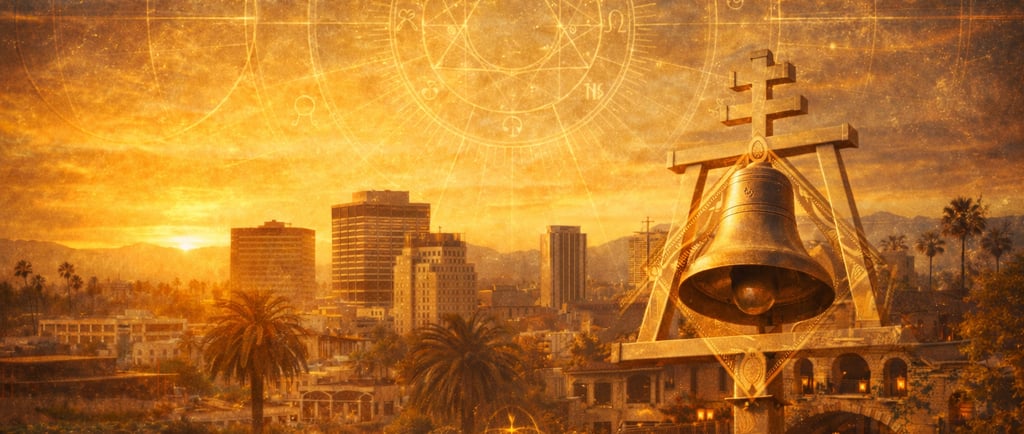
Third, the project analyzes material mediation. Objects such as the Raincross symbol officially fixed atop and part of Riverside city’s acclaimed missionary bell logo, curated “sacrificial rocks,” eclectic architectural programs, and decorative collections at the Mission Inn did not merely embellish Riverside’s aesthetic. They constructed an “invented tradition” that grounded metaphysical imagination in the Southern California landscape.[4] Rather than dismissing these displays as commercial kitsch, this research evaluates how they functioned as mediators of spiritual meaning and civic mythmaking.
Fourthly, this research employs regional comparison. By contrasting Riverside with Northeastern parlor Spiritualism and Southern Christian Spiritualism, it identifies a Western pattern characterized by environmental rhetoric, therapeutic language, and integration into municipal identity. The Western landscape itself—its climate, health culture, and booster narratives—became part of the religious vocabulary. This comparative lens clarifies what was genuinely distinctive about Riverside rather than assuming it merely replicated Eastern models.
Throughout, this project maintains definitional precision. The category “metaphysical religion” serves as an analytical umbrella describing movements characterized by belief in correspondences, mental healing, spiritual evolution, and combinative appropriation of traditions. It distinguishes this from narrower “Spiritualism” and from the overly broad and often polemical term “occult.” Such clarity prevents conceptual slippage and preserves historical accuracy.
Why This Matters
This study contributes to broader debates within American religious history. For decades, scholars have wrestled with narratives of secularization, disenchantment, and the supposed decline of supernatural belief in the modern age. Yet Riverside’s case suggests a more complex pattern. Rather than retreating from public life, metaphysical religion adapted to urban development, booster culture, and Progressive reform. Spiritual experimentation coexisted with civic respectability.
By embedding occult and metaphysical religion within municipal institutions—architecture, tourism, women’s clubs, print networks, and public symbolism—Riverside challenges assumptions that modernity necessarily marginalized esoteric belief. Instead, it demonstrates that religious innovation often moved alongside commercial expansion, urban planning, and cultural mythmaking.
This regional case also strengthens the field’s commitment to studying lived and material religion.[5] Belief did not operate only at the level of doctrine or denominational structure. It circulated through spaces, objects, printed advertisements, and civic narratives. In Riverside, metaphysical religion shaped public identity not by dominating institutions but by quietly integrating into them.
Scholarly Preparation
This research grows out of sustained graduate training in religion, theology, and historical method, combined with archival research and engagement with local collections. Doctoral training in history provides the methodological discipline necessary to ground interpretation in primary sources and contextual analysis. Prior academic work on metaphysical symbolism and material religious culture further equips this project to treat its subject with both intellectual seriousness and analytical restraint.
What This Study Hopes to Uncover
Ultimately, this dissertation work seeks to uncover how metaphysical religion moved from private experiment to civic legitimacy in a developing Western city. It aims to clarify how newspapers normalized spiritual practice, how public venues conferred authority, how material symbols constructed usable pasts, and how regional identity reshaped religious imagination.
The story of American religion cannot be told solely through doctrinal conflict or denominational growth. It must also account for the civic spaces, printed words, and material forms through which Americans negotiated the sacred in everyday public life. Riverside offers a compelling lens through which to examine that negotiation.
Footnotes:
[1] Ann Braude, Radical Spirits: Spiritualism and Women's Rights in Nineteenth-Century America (New York: Indiana University Press, 2001), 58, 193, accessed February 15, 2026, ProQuest Ebook Central.
[2] Catherine L. Albanese, A Republic of Mind and Spirit: A Cultural History of American Metaphysical Religion (New Haven: Yale University Press, 2007), 222–25.
[3] Mark S. Morrisson, "The Periodical Culture of the Occult Revival: Esoteric Wisdom, Modernity and Counter-Public Spheres," Journal of Modern Literature 31, no. 2 (2008): 4–5, Gale Literature Resource Center, accessed February 15, 2026, https://link.gale.com/apps/doc/A176858147/LitRC?u=vic_liberty&sid=summon&xid=cf21ff9d.
[4] Emily Ann McEwen, "Southern California’s Unique Museum-Hotel: Consuming the Past and Preserving Fantasy at Riverside’s Mission Inn, 1903-2010" (PhD diss., University of California, Riverside, 2014), 16–21, 36–40.
[5] Colleen McDannell, Material Christianity: Religion and Popular Culture in America (New Haven and London: Yale University Press, 1995), 163-97.